Pool Financing Options Compared: Cash, Home Equity, Refinancing or a Pool Loan?
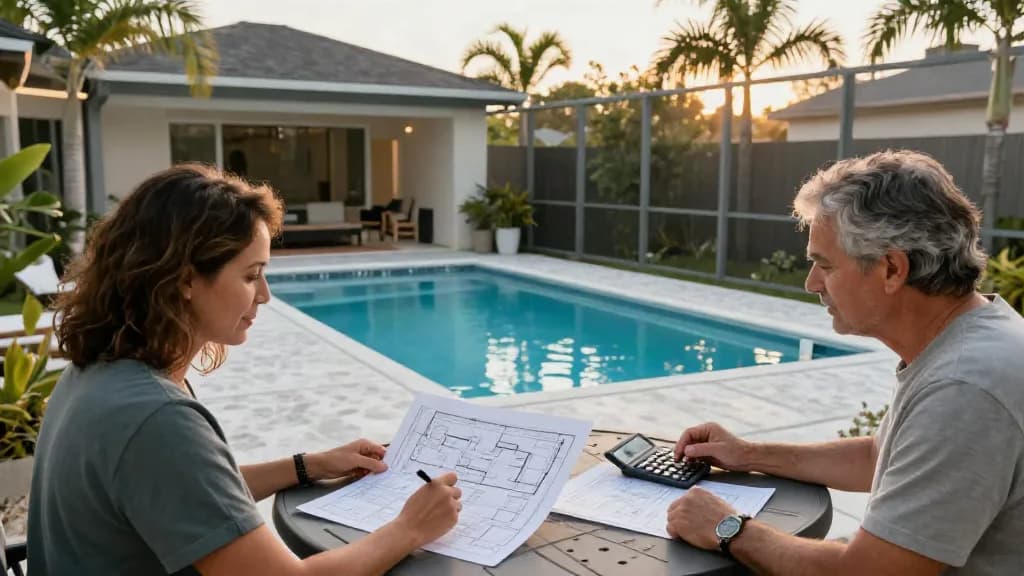
There is more than one way to pay for a new pool or a resurfacing project. The right one depends less on the pool and more on your home, your savings and your comfort with risk.
Once a homeowner has a design and a written quote in hand, the next question is almost always the same: how do we actually pay for this?
For most families in Central Florida, the answer comes down to five or six options. Each one works differently, is secured differently and carries different trade-offs. None of them is "best" for everyone.
This guide compares them side by side in plain language. It does not quote rates, payments or terms, because those change constantly and depend on your own credit and the lender. What doesn't change much is how each option is built, and that's what you need to understand first.
Quick answer: You can pay for a pool with cash or savings, borrow against your home (a home equity loan, a HELOC or a cash-out refinance), take an unsecured personal or pool loan, or apply through a lender that partners with your contractor. Loans backed by your home put the house on the line if you can't pay; unsecured loans don't use the house as collateral but may come with lower limits or higher costs. Compare total cost, not just the monthly payment.
This article is general education, not financial or legal advice. Talk to a lender, a housing counselor or a financial professional about your own situation.
Option 1: Cash or Savings
Paying out of pocket is the simplest route. There is no application, no interest and no lien.
The trade-off is liquidity. Draining an emergency fund to build a pool can leave a household exposed if the air conditioner fails, a roof needs work or income changes. Some homeowners split the difference: they pay part in cash and finance the rest, or they pay cash for the pool and finance later items like decking.
If you go this route, keep in mind that a pool project usually involves more than the pool itself (permits, a safety barrier, decking, landscaping). Budget for the whole project before you decide cash covers it.
Option 2: Home Equity Loan
A home equity loan lets you borrow against the equity in your home, meaning the value of the home minus what you still owe on your mortgage.
According to the Consumer Financial Protection Bureau, a home equity loan pays you in one lump sum, and if you already have a mortgage it is considered a second mortgage that you pay in addition to your first one.
That structure fits a project with a fixed, known price, such as a pool built under a written contract. The catch is that your home is the collateral. If you fall behind, the house is at risk.
Option 3: Home Equity Line of Credit (HELOC)
A HELOC also uses your home's equity, but instead of a lump sum it works more like a line of credit. The CFPB explains that you can draw money multiple times up to a maximum, and that HELOC rates are usually adjustable, so the payment can change.
Some homeowners like a HELOC for a pool because construction is paid in stages: you draw as each milestone comes due. The downside is the variable payment and, again, the fact that the home secures the debt. The CFPB's HELOC overview is worth reading before you sign anything.
Option 4: Cash-Out Refinance
With a cash-out refinance, you replace your existing mortgage with a bigger one and take the difference in cash. The CFPB notes in its comparison of HELOC alternatives that closing costs are often involved and that you should pay close attention to the new interest rate, especially if it's higher than the one you have now.
This option rewrites your whole mortgage, not just the pool portion, and works like any mortgage closing.
Option 5: Unsecured Personal or Pool Loan
An unsecured loan is based on your credit and income rather than your home. Many banks, credit unions and specialty lenders offer personal or home improvement loans that can be used for a pool.
The appeal is clear: the house is not pledged as collateral. The CFPB notes that credit that isn't backed by your home may come with lower limits and higher rates than options that use the home as collateral. That's the trade-off you're weighing.
Option 6: Contractor-Partner Lenders
Many pool builders work with lenders that specialize in pool and outdoor projects. At D&J, our pool financing page lets homeowners estimate a monthly payment and apply with Lyon Financial or Viking Capital. Financing is subject to credit approval.
A partner lender can be convenient because it already knows how pool contracts and payment schedules work. Still, treat it like any other offer: ask how the loan is structured, whether it is secured, what the APR and total cost are, and whether there is a prepayment penalty. Then compare it with at least one other option. Our earlier post, Pool Financing in Orlando: How Much Does It Really Cost Per Month?, walks through how the D&J process works from estimate to approval.
Side-by-Side Comparison
| Option | How you get the money | What secures it | Main advantage | Main trade-off |
|---|---|---|---|---|
| Cash / savings | You already have it | Nothing | No interest, no lien | Reduces your safety cushion |
| Home equity loan | One lump sum | Your home | Fits a fixed project price | Home is at risk if you can't pay |
| HELOC | Draw as needed up to a limit | Your home | Pay for stages as they come due | Usually variable payment; home at risk |
| Cash-out refinance | New, larger mortgage | Your home | One mortgage payment | Rewrites your whole mortgage; closing costs |
| Unsecured personal / pool loan | Lump sum | Your credit (no collateral) | Home not pledged | May have lower limits or higher cost |
| Contractor-partner lender | Through the contractor's lender | Ask the lender | Familiar with pool projects | Still needs side-by-side comparison |
What Lenders Typically Look At
Every lender has its own rules, but most approval decisions weigh a similar set of factors:
- Credit history and score. Your record of paying debts on time.
- Income and employment. Whether you can show stable income to support a new payment.
- Debt-to-income ratio. The CFPB defines debt-to-income as all your monthly debt payments divided by your gross monthly income. Acceptable limits vary by lender and product.
- Home equity and value (for home-secured options). How much you owe compared with what the home is worth.
- Project documentation. A written contract or itemized quote from a licensed contractor.
Our companion guide, How to Get Ready to Finance a Pool (and Get Approved), covers each of these in more detail.
How to Compare Offers Fairly
Monthly payment is the number everyone looks at first, and it's the easiest one to misread. A longer term can lower the payment while raising the total you pay.
The CFPB explains that the APR is the interest rate plus additional lender fees, so compare APR to APR, never APR to interest rate. Also ask each lender for the total amount you'll repay over the life of the loan, the fees at closing and whether you can pay the loan off early without a penalty.
Frequently Asked Questions
Can I finance a pool resurfacing, or only a new pool?
Many lenders finance both. A resurfacing has a clear, defined scope, which makes it straightforward to document. Ask the lender whether your specific project qualifies.
Is a HELOC or an unsecured loan better for a pool?
It depends on your equity, your credit and how you feel about using your home as collateral. A HELOC is backed by your home and usually has a variable payment. An unsecured loan doesn't pledge the house but may have lower limits or higher costs. Compare real offers before choosing.
Do I need my contractor's quote before applying?
It helps. Most lenders want to know the amount you need, and a written, itemized quote shows exactly what the money pays for. At D&J we provide a written, itemized quote after seeing your pool or yard.
Does D&J set the financing terms?
No. The lender sets the terms and makes the credit decision. Our financing page simply lets you estimate a payment and apply with Lyon Financial or Viking Capital, subject to credit approval.
Can I combine cash and a loan?
Yes. Many homeowners pay part of the project in cash and finance the rest, or finance the pool and pay cash for later extras. A smaller loan generally means less interest paid overall.
Start With the Number, Then Choose the Loan
The smartest financing decision starts with an accurate project number. Design the pool you actually want, get a written quote that includes everything, and only then compare how you'll pay for it.
If you'd like to start, design your pool in our free 3D builder or request a free estimate. D&J has served Central Florida since 2014 (CPC1459797), and you can reach us at (689) 358-9790. Se habla español.
Written and reviewed by
D&J The Pool Resurfacers
A Florida-licensed pool contractor and certified PebbleTec applicator that resurfaces, remodels and builds pools across Central Florida, working with pebble, quartz and polished finishes.
- Florida Certified Pool/Spa Contractor
- CPC1459797 · Verify the license on MyFloridaLicense.com
- PebbleTec
- Certified PebbleTec applicators
- Last updated
Why trust this article: it’s written by the licensed crew that does this work in Central Florida, and it only states what we do on our own jobs — pebble, quartz and polished finishes. More about D&J